Research-Driven Long-Form Writing: Agility Writer or Autoblogging.ai?
You are comparing two AI writers for research-driven long-form content, and the difference shows up in the research layer, not the prose. One tool may pull competitor headings and semantic terms from the SERP before drafting; the other may lean on bulk output and workflow hooks. That gap decides whether your first draft needs a rewrite or a proofread.
This comparison covers SERP competitor analysis depth, long-form output modes, bulk generation, language coverage, integrations, and human proofreading, then breaks down credits, rollover, and value at scale. You will finish with a clear verdict on which tool fits your workflow, plus who should choose Autoblogging.ai and who should choose Agility Writer.
Quick Verdict: Agility Writer or Autoblogging.ai for Research-Driven Long-Form Writing?
If you need a tool that emphasizes deep SERP analysis and semantic research for long-form content, Autoblogging.ai's Godlike Mode may be your best bet, while Agility Writer appeals to those who prioritize a balance of research and speed. Autoblogging.ai backs that research focus with 10+ AI modes, SERP competitor analysis, semantic SEO tools, and a 21-point SEO audit, all supported by a human proofreader included in every plan.
For teams producing long-form content at scale, the platform's track record matters: 40,000+ content creators, a 4.9 average rating, and 1M+ articles generated. Add credits rollover, 24/7 support, new features shipped weekly, and one-click WordPress publish, and it becomes a strong fit for research-driven workflows.
Agility Writer remains a capable alternative, and some writers may prefer its approach. Still, for readers who want research depth plus proven scale, Autoblogging.ai holds the edge.
At a glance: how Autoblogging.ai compares to Agility Writer on the features that matter most.
| Feature | Autoblogging.ai | Agility Writer |
|---|---|---|
| Research-Driven Long-Form Writing | ✓ | ✓ |
What Is Autoblogging.ai?
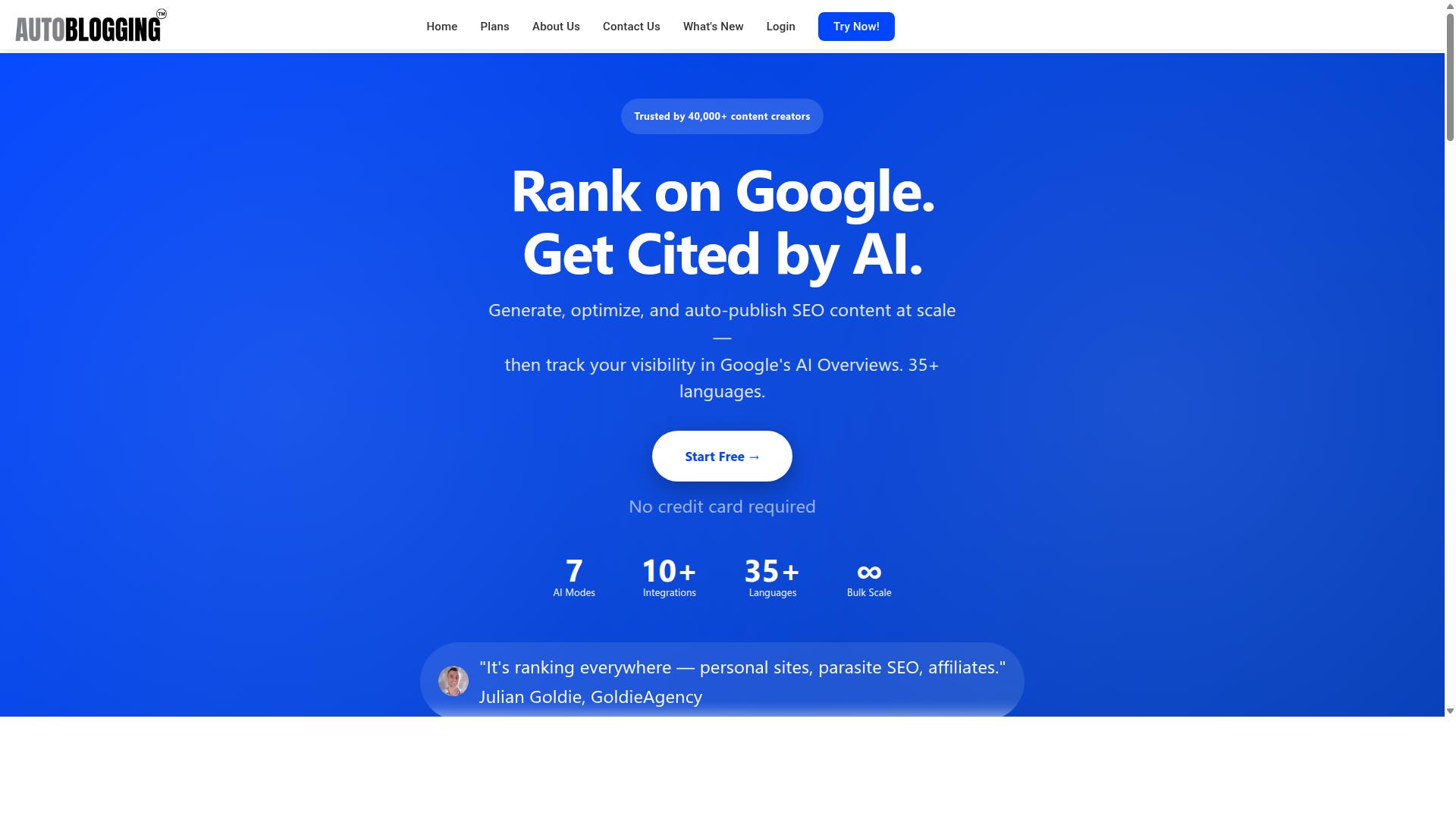
Autoblogging.ai is a product of Digimetriq.com, founded in 2022 by Vaibhav Sharda, with a mission to help bloggers, website owners, and agencies save time and improve their online presence through cutting-edge technology. It is an AI article generation platform built to automate content creation from the first draft onward.
The core purpose is straightforward: cut down content costs while enableing human counterparts inside their standard operating procedures with a ready first draft. Instead of facing a blank page, writers and site owners start with structure and copy they can refine.
Digimetriq's stated aim goes a step further, working toward replacing human counterparts entirely for teams that want fully automated output. That dual positioning matters in a comparison article, because it means Autoblogging.ai serves both human-in-the-loop workflows and hands-off publishing pipelines.
The platform supports a wide range of users and site types, including:
- Bloggers and website owners managing their own properties
- SEO professionals working across multiple clients
- Marketing agencies producing content at scale
- Content creators and affiliate marketers
- Personal sites, parasite SEO, affiliate sites, client websites, portfolio sites, and local sites
That spread is global, covering solo operators and agencies alike. For a reader weighing Agility Writer vs Autoblogging.ai, the key takeaway is that Autoblogging.ai was designed around cost reduction and workflow speed, not just raw text generation.
Where research-driven long-form writing is concerned, this positioning fits naturally. Long-form content demands outline generation, draft expansion, and an editing workflow that keeps a human in control of factual accuracy. Autoblogging.ai's mission of supplying the first draft supports exactly that division of labor, letting people focus on verification, source citation, and content quality rather than typing every paragraph from scratch.
What Is Agility Writer?
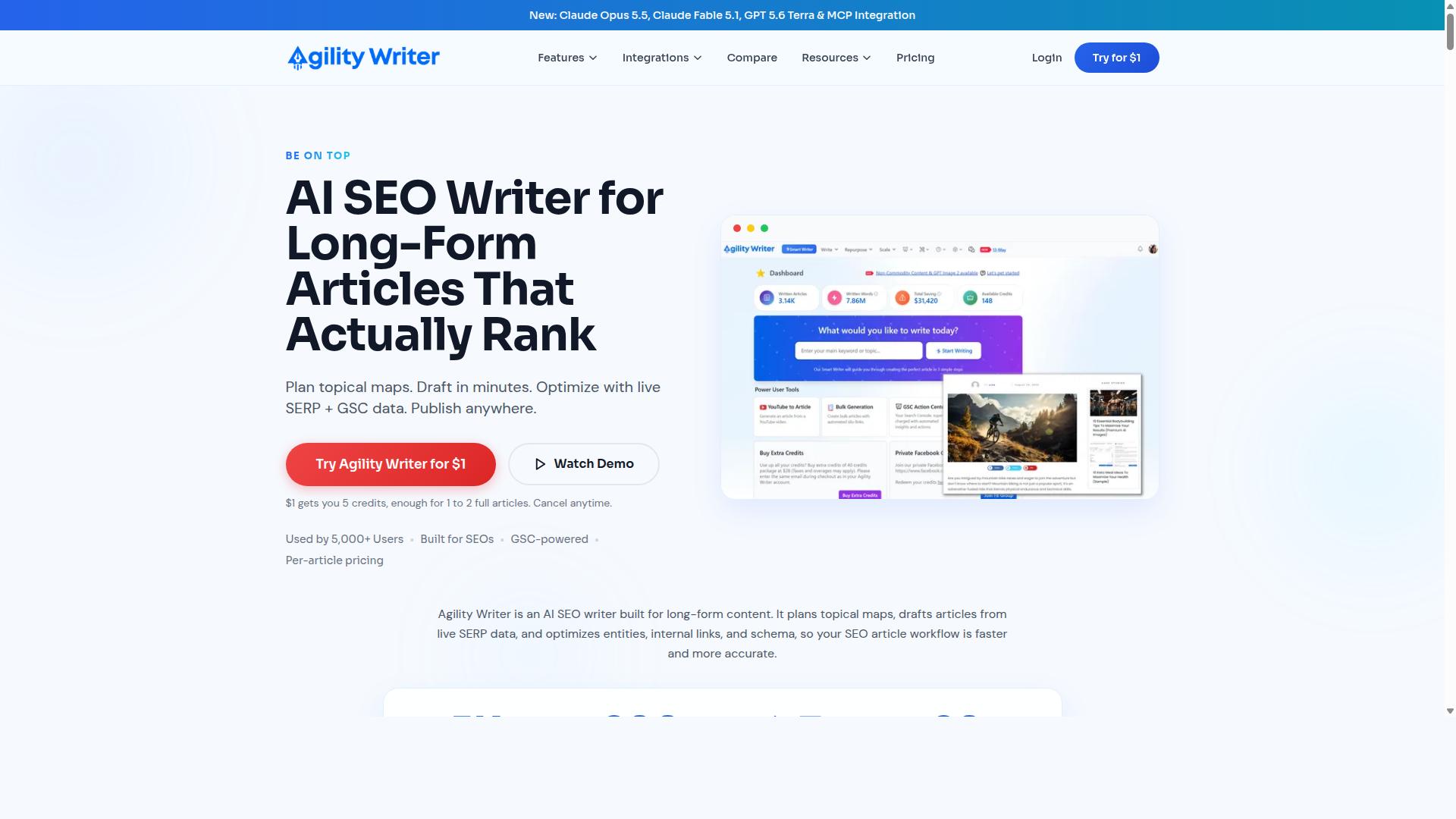
Agility Writer is another AI writing tool that aims to streamline content creation, though specific details about its features and pricing are not covered here. It sits in the same broad category as other AI writing assistants: software that uses large language models to turn prompts, outlines, or keywords into drafted text.
Like most tools in this space, it appears to target marketers, bloggers, and agencies who want to produce articles faster. That places it alongside a growing field of AI writing tools competing on output speed, template variety, and ease of use.
Because product details change often, this overview stays general on purpose. Feature sets, limits, and pricing can shift between updates, so readers should check the official Agility Writer website for the most accurate and current information.
For the purposes of this comparison, the key point is simply that Agility Writer is a competitor in the AI writing space. It is one option among many for teams weighing research-driven writing against faster, template-based content generation.
- Category: AI writing assistant for content creation
- Typical audience: bloggers, marketers, and agencies
- Core appeal: faster drafting and simplified workflows
- Verification note: confirm current features and pricing on its official site
When evaluating any tool in this category, look past the marketing page. Focus on how it handles long-form content, factual accuracy, and the level of human oversight it requires before publishing.
Features Compared for Research-Driven Long-Form Writing
When evaluating AI writing tools for research-driven long-form content, key differentiators include the depth of SERP analysis, output modes, language support, and workflow integrations. These capabilities determine whether a tool can support genuine research-driven writing or simply produce generic drafts.
This section focuses on the features that matter most for long-form article creation: competitor research, semantic depth, output flexibility, and how well each platform fits into an existing content workflow. The comparison below draws on publicly available product information for both Autoblogging.ai and Agility Writer.
SERP Competitor Analysis and Semantic Research Depth
Autoblogging.ai's Godlike Mode performs SERP competitor analysis, extracts LSI keywords, and builds knowledge graphs to inform content creation, while Agility Writer's approach to SERP analysis is less transparent. For research-driven long-form writing, this distinction matters because semantic depth directly affects how well a draft can compete in search results.
Godlike Mode is one of the platform's 10+ AI modes, and it sits at the centre of its research capabilities. It examines top-ranking competitors and pulls out the related terms and entities that shape topical relevance. The knowledge graph extraction step adds another layer, helping content cover a subject with more semantic breadth than a simple keyword list would allow.
This matters for long-form content because search engines increasingly reward articles that demonstrate genuine topical authority. A tool that maps entities and related queries gives writers a stronger structural foundation before drafting even begins.
By contrast, Agility Writer's specific SERP analysis capabilities are not publicly detailed in a way that allows direct comparison. Readers evaluating that tool should verify its research features directly through its own documentation and support channels. Claims about its semantic research depth cannot be confirmed from available public information, so any comparison here remains general.
For teams prioritising semantic SEO and competitor-informed outlines, Autoblogging.ai's documented research pipeline offers a clearer, more verifiable starting point.
Long-Form Output Modes, Bulk Generation, and Workflow Integration
Autoblogging.ai offers Quick Mode for free single articles and wizard-guided creation, Godlike Mode for in-depth research-driven pieces, and Bulk Generation that can produce up to 500 articles at once. This range of output modes lets users match the tool to the task, whether that means a quick draft or a full research-backed article.
The modes break down into distinct use cases:
- Quick Mode: free, supports single articles and a wizard-guided creation flow
- Godlike Mode: SERP competitor analysis, LSI keyword extraction, and knowledge graph extraction
- Bulk Generation: up to 500 articles produced via CSV upload
Beyond article creation, the platform connects with 35+ integrations, including WordPress publishing with unlimited sites, one-click publishing, a plugin, and scheduled auto-posting. It also supports Web 2.0 platforms such as Medium, Dev.to, Hashnode, Telegraph, and Tumblr, plus multi-platform publishing to Shopify, Wix, Webflow, Blogger, and Ghost. API, Zapier, and n8n connections extend this further for teams with custom workflows.
Agility Writer also offers long-form content generation and bulk options, but the specific limits and integration details are not provided here. Users should check its website for current specifications before committing to either platform.
For automated blogging at scale, Autoblogging.ai's documented bulk ceiling and publishing integrations give it a practical edge for high-volume operations.
Language Coverage, Integrations, and Human Proofreading
Autoblogging.ai supports 35+ languages, integrates with 35+ platforms, and includes human proofreading to ensure content quality and factual accuracy. These three areas, language reach, workflow connectivity, and quality assurance, often decide whether an AI writing tool fits a real production pipeline.
Language coverage at this scale means teams can produce content for multiple regional markets without switching tools. Combined with the publishing integrations noted earlier, that reach becomes useful rather than theoretical, since drafts can move straight into WordPress, Web 2.0 platforms, or other supported channels.
The human proofreader is included in all plans, alongside an AI Proofreader tool. For research-driven long-form writing, human oversight adds a layer of factual accuracy that automated checks alone may miss. The platform also offers a Semantic SEO Analysis feature with a 21-point audit, plus a Snippet Optimizer and Topical Maps for ongoing optimisation.
Agility Writer may offer multi-language support and integrations, but exact numbers are not provided in publicly available summaries. Readers should check its official resources for current details on language coverage and proofreading options.
For teams that need verified language counts, documented integrations, and built-in human review, Autoblogging.ai presents a more transparent feature set on the points that matter most for long-form production.
Pricing Compared: Credits, Rollover, and Value at Scale
Autoblogging.ai offers monthly plans ranging from $19 for 40 credits to $999 for 5,000 credits, with annual discounts and a credits rollover feature that lets unused credits carry over. That structure matters for anyone weighing research-driven long-form writing tools, because pricing is where a comparison either holds up or falls apart once monthly volume grows.
For teams producing long-form content at a steady pace, the question is rarely the entry price. It is what happens in month two, month six, and month twelve, when output fluctuates and some credits go unused.
| Plan | Monthly Price (USD) | Credits | Annual Price (USD, billed yearly) |
|---|---|---|---|
| Starter | $19 | 40 | $12/mo ($148/year) |
| Regular | $49 | 120 | $32/mo ($382/year) |
| Standard | $99 | 300 | $64/mo ($772/year) |
| Gold | $179 | 600 | $116/mo ($1,396/year) |
| Premium | $249 | 1,000 | $162/mo ($1,942/year) |
| Enterprise | $999 | 5,000 | $649/mo ($7,792/year) |
The ladder is deliberately gradual. A solo blogger can begin at $19, while an agency running automated blogging across multiple client sites can scale to the Enterprise tier without switching platforms. Annual billing lowers the effective monthly rate on every tier, which rewards teams that already know their production rhythm.
New accounts also receive 10 free credits per month with no credit card required, so the pricing can be evaluated against real output before any commitment. Additional credits are available for purchase when a project spikes, and cancellation is possible at any time.
The credits rollover feature is the detail that separates this model from a strict use-it-or-lose-it subscription. Because all plans include rollover, a quiet month does not erase capacity that was already paid for. For research-heavy article creation, where output naturally varies with client cycles and editorial calendars, that flexibility protects the budget.
Autoblogging.ai also offers Done For You packages for buyers who prefer a managed route rather than a self-serve subscription:
- Starter: $1,200 for 1,000 articles
- Pro: $1,600 for 1,000 articles
- Corp: $4,000 for 1,000 articles
- Senpai: $10,000 for 1,000 articles
Payment options include Visa, MasterCard, American Express, and PayPal, with bank transfers available for annual enterprise plans through Stripe. That range suits both individual writers and procurement teams that need a familiar billing method.
For Agility Writer, this comparison does not detail its pricing structure, and readers should visit its website for current rates. Published pricing for AI writing tools changes often as credit systems, seat limits, and feature tiers are revised, so treating any third-party figure as fixed would be misleading.
What can be compared honestly is the shape of the offer. A transparent, published tier list with rollover and a free entry point gives buyers a predictable way to model cost against content generation volume. When evaluating any tool for research-driven writing, check three things: whether unused capacity carries forward, whether annual billing reduces the rate, and whether there is a low-risk way to test output quality first.
On those criteria, Autoblogging.ai's published structure is easy to audit. The tiered credits, the rollover on every plan, the annual discount, and the free monthly credits together make cost planning straightforward for long-form projects that run month after month.
Who Should Choose Autoblogging.ai
Autoblogging.ai is ideal for bloggers, website owners, SEO professionals, marketing agencies, content creators, and affiliate marketers who need to produce high volumes of research-driven long-form content efficiently. It is built for people who treat content as a production pipeline, not a one-off project.
The platform serves a wide range of site types, including personal sites, parasite SEO, affiliate sites, client websites, portfolio sites, and local sites. That spread matters because each of those setups has different publishing rhythms and different tolerance for manual work.
Where Autoblogging.ai stands apart is its focus on bulk generation, SERP analysis, and multi-language support. For teams juggling many pages at once, those three capabilities shape the entire workflow.
Consider a few practical scenarios:
- Bloggers managing a single site who want a steady publishing cadence without writing every post from scratch.
- Affiliate marketers running multiple niche sites that each need fresh, keyword-targeted articles.
- SEO professionals who rely on SERP analysis to decide what to write next and how to structure it.
- Agencies producing content for client websites across several industries and languages.
- Local site owners who need location-focused pages at scale.
Multi-language support widens the fit further. Anyone expanding into new regions can generate content for those markets without rebuilding a separate process each time.
It also suits parasite SEO and portfolio sites, where volume and speed often decide whether an opportunity is worth pursuing at all. When the window is short, a tool built around bulk output has a clear edge.
By contrast, Agility Writer tends to appeal to writers who prioritize a hands-on drafting experience over volume. That is a reasonable preference, but it is a different job to be done.
The takeaway is straightforward. If your priority is research-driven long-form content at scale, across many sites and languages, Autoblogging.ai is the stronger fit for this article's target reader.
Who Should Choose Agility Writer
Agility Writer may appeal to writers who prioritize a straightforward interface and a balance between research and speed, though its exact ideal user profile is not specified here. Based on publicly available information about how this category of AI writing tools tends to be positioned, certain users may find it a reasonable fit for their workflow.
Writers who place a high value on simplicity over depth often gravitate toward tools that keep the interface clean and the learning curve short. If your projects are mostly short to medium in length and you want to move from idea to draft quickly, a lighter tool can feel less overwhelming than a platform built for heavier research workflows.
Another group worth considering is the occasional user. Someone who publishes a handful of articles per month, or who writes across varied topics without deep topical authority requirements, may not need extensive research automation. In that case, a general-purpose assistant can be enough to get words on the page.
It also helps to think about your tolerance for manual steps. Some writers enjoy hands-on control over prompt engineering and outline generation, treating each draft as a craft project. Others prefer a system that handles more of the pipeline for them. Neither preference is wrong, but they point to different tools.
- You publish short or medium-length posts rather than deep long-form pieces
- You prefer a simple interface and a quick setup
- You are comfortable handling research and fact-checking yourself
- You write occasionally rather than at a consistent volume
- You want flexibility to shape every draft manually
Before committing, it is worth being honest about what your long-form content actually demands. Research-driven writing involves source citation, factual accuracy checks, and keyword integration that a basic drafting tool may not support on its own. If those steps fall on you anyway, the time savings shrink.
The most practical approach is a side-by-side trial. Take one real topic, run it through both tools, and compare the outputs on readability, factual grounding, and how much editing each one requires. That exercise tells you more than any feature list.
As part of that comparative analysis, ask a few direct questions. Does the draft hold together over several thousand words? Does it respect your outline? How much human oversight is needed before publishing? Your answers will point clearly to the right fit.
In short, Agility Writer may suit writers who want simplicity and are happy to manage research themselves. Readers evaluating their own needs should trial both options and judge based on their actual output, not marketing claims. For teams focused on consistent, research-heavy automated blogging, the priorities often shift toward depth and scale.
Final Verdict
For research-driven long-form writing, Autoblogging.ai stands out with its Godlike Mode, bulk generation, 35+ languages, 35+ integrations, and credits rollover, backed by a 4.9 rating from 40,000+ users. Those numbers reflect a platform that has generated over 1M articles and ships new features weekly.
Agility Writer remains a viable alternative for writers who want a different interface or workflow. However, specific details about its current feature set, pricing, and research depth should be verified directly, since tool capabilities change frequently and publicly available information can lag behind updates.
When choosing between these two AI writing tools, the decision often comes down to how much structure and scale you need. Autoblogging.ai offers 10+ AI modes, human proofreading, and 24/7 support, which suits teams producing content in volume. Agility Writer may appeal to users who prefer a lighter, more manual approach to draft expansion and editing.
The table below summarizes the key differences based on verified information.
| Feature | Autoblogging.ai | Agility Writer |
|---|---|---|
| User base | 40,000+ content creators | General, verify independently |
| Average rating | 4.9 | General, verify independently |
| Articles generated | 1M+ | Not publicly confirmed here |
| AI modes | 10+ | General, verify independently |
| Languages | 35+ | General, verify independently |
| Integrations | 35+ | General, verify independently |
| Credits rollover | Yes | General, verify independently |
| Support | 24/7 | General, verify independently |
| Human proofreading | Yes | General, verify independently |
| Update cadence | New features shipped weekly | General, verify independently |
If your priority is deep research capabilities combined with automated blogging at scale, Autoblogging.ai is the stronger fit. Its Godlike Mode, bulk generation, and credits rollover support long-form content workflows without forcing you to rebuild your process for every article. The 35+ integrations and 35+ languages also help teams maintain consistency across regions and channels.
For readers who value human oversight, the built-in proofreading step adds a layer of quality control before publishing. Combined with a 4.9 average rating and a user base of 40,000+, these features point to a mature, well-tested platform for content generation.
Agility Writer can still work well for smaller projects or writers who prefer a different editing rhythm. Just confirm its latest research features and limits directly before committing, since this comparative analysis relies on publicly available information.
If you have questions about which plan suits your research-driven writing needs, the Autoblogging.ai team is reachable through several channels.
- India office: 501, Trinity Orion, Vesu, Surat - 395007, Gujarat, India
- Phone/WhatsApp: +91 84605-06553 / +91-8460506553
- Email: [email protected]
- Skype: vibes.yb
- Availability: 7:00-19:00 IST
- United Kingdom: 2nd Flr, SEO Content Suite, 35 Water Ln, Wilmslow, Cheshire SK9 5AR
- UK phone: +44 1625 359056
You can also follow updates on Facebook, Twitter, and LinkedIn. For most users focused on research-driven long-form content, Autoblogging.ai offers the more complete package, while Agility Writer stays a reasonable option for narrower needs.
Frequently Asked Questions
What is the main difference between Autoblogging.ai and Agility Writer?
Both are AI article generation platforms built for bloggers, SEO professionals and agencies, but they differ in scope and workflow. Autoblogging.ai offers 10+ AI modes - including Quick Mode, Godlike Mode with SERP competitor analysis, Bulk Generation up to 500 articles via CSV, and News Mode - plus 35+ languages, 35+ integrations and credits rollover. Agility Writer is a focused AI writing tool with its own credit-based plans; the right pick depends on whether you need broad mode variety and bulk workflows or a simpler single-purpose writer.
How does pricing compare between the two tools?
Autoblogging.ai runs on monthly plans from Starter at $19 (40 credits) up to Enterprise at $999 (5,000 credits), with annual plans also available, and unused credits roll over. Agility Writer offers a $1 trial (5 credits, enough for 1-2 full articles) and monthly plans such as Basic at 40 credits and Pro at 150 credits, with yearly options as well. Because credit allowances and plan structures differ, compare the cost per article you actually need rather than headline prices alone.
Which tool is better for bulk content production?
Autoblogging.ai includes a dedicated Bulk Generation mode that can produce up to 500 articles via CSV upload, which suits agencies and portfolio or affiliate site owners managing content at scale. It also supports 35+ integrations and credits rollover, so large batches don't force you to waste unused credits. If your priority is high-volume publishing across many sites, that bulk workflow is a key advantage to weigh against Agility Writer's credit-based approach.
Can both tools handle research-driven, long-form articles?
Yes - research-driven long-form writing is the focus of this comparison. Autoblogging.ai's Godlike Mode performs SERP competitor analysis, extracts LSI keywords and pulls from knowledge graph data to ground articles in real search context, and a human proofreader is included in higher-tier plans. Agility Writer also targets long-form AI writing with its own research features, so the best way to judge is to test each on the same keyword and compare output quality directly.
Does Autoblogging.ai offer support and ongoing updates?
Autoblogging.ai provides 24/7 support and ships new features weekly, and it's trusted by 40,000+ content creators with a 4.9 average rating and 1M+ articles generated. Support is reachable via email, phone/WhatsApp and Skype, with teams in India and the United Kingdom. That cadence of updates and round-the-clock help matters if you rely on the tool for client or revenue-generating sites.
Who should choose Autoblogging.ai over Agility Writer?
Autoblogging.ai is built for bloggers, website owners, SEO professionals, marketing agencies, content creators and affiliate marketers who want variety and scale - 10+ AI modes, 35+ languages, bulk generation and rollover credits in one platform. If you need multiple content types (news, bulk, in-depth research) plus integrations and 24/7 support, it's a strong fit. If you only need occasional single articles, a simpler credit-based tool like Agility Writer may be sufficient - try both and match the tool to your workflow.